

The 28 October 2026 opening of expanded manufacturing capacity in
Sendayan and a new maintenance, repair and overhaul centre in Nilai adds
a significant advanced-manufacturing and aftermarket-services milestone
to Negeri Sembilan.
The investment at a glance
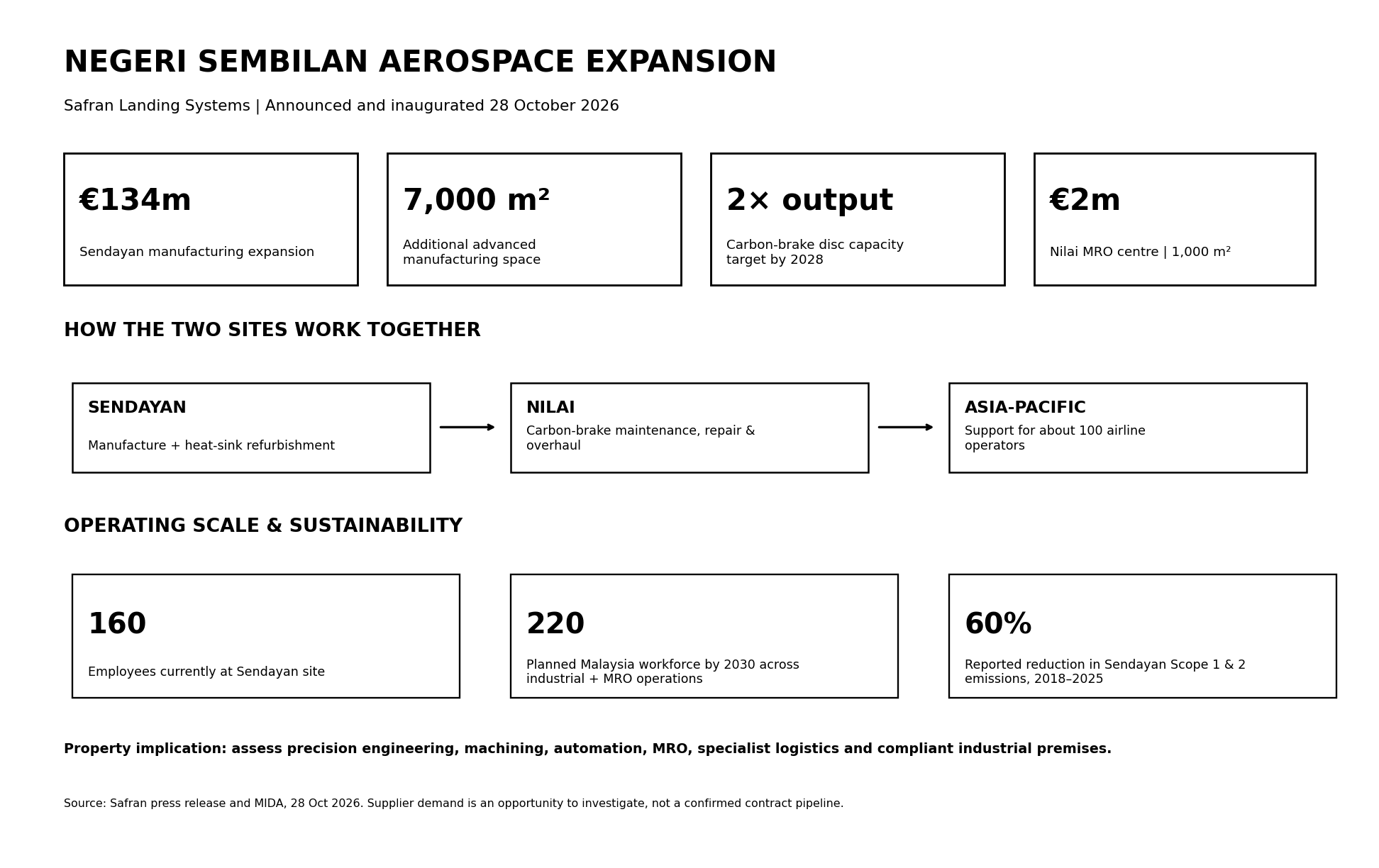
Safran Landing Systems inaugurated two complementary facilities in
Negeri Sembilan on 28 October 2026:
- Sendayan: a €134 million expansion of its carbon-brake
manufacturing and heat-sink refurbishment facility, adding 7,000
square metres of advanced manufacturing space. - Nilai: a separate €2 million, 1,000-square-metre carbon-brake
maintenance, repair and overhaul (MRO) centre, located near Kuala
Lumpur International Airport and about 20 kilometres from Sendayan.
The Sendayan expansion includes a new textile line, carbonisation
furnaces and advanced machining equipment. Safran expects the site to
double its carbon-brake disc production capacity by 2028. The facilities
are intended to support the needs of about 100 airline operators across
Asia-Pacific, including fleets using Airbus, Boeing and ATR aircraft.
Safran said the Sendayan site currently employs 160 people. It plans to
increase its Malaysian workforce to 220 employees by 2030 across its
industrial and MRO operations.
Sources: Safran, 28 October
2026
and MIDA's October 2026 media-release
archive.
Why the two-site model matters
The development is more than an increase in factory floor area. It links
manufacturing and refurbishment in Sendayan with aftermarket MRO
activity in Nilai.
That arrangement creates a connected operating model:
- Carbon-brake discs and related components are manufactured or
refurbished at Sendayan. - New and refurbished components support MRO activity at Nilai.
- The Nilai centre is positioned close to KLIA and serves airline
operators across the Asia-Pacific region.
For aerospace supply-chain manufacturers, the distinction matters. A
manufacturing site and an MRO support site can have different property
requirements. Production may prioritise process engineering, equipment
foundations, power quality, environmental controls and manufacturing
space. MRO operations may place greater emphasis on parts inventory,
controlled handling, turnaround time, technician access and proximity to
the airport.
Where supplier opportunities may emerge
Safran has not announced a public list of new supplier contracts arising
from this expansion. It would therefore be inaccurate to claim that a
particular number of new factories or supplier premises will be
required.
However, the equipment and processes disclosed by Safran indicate
categories of industrial capability that aerospace suppliers may wish to
assess:
1. Precision engineering and machining
The expanded Sendayan facility includes advanced machining equipment.
This is a relevant signal for companies involved in precision machining,
tooling, fixtures, metrology, equipment maintenance and high-tolerance
component production.
A prospective supplier should confirm the buyer's quality-system,
traceability, inspection and qualification requirements before investing
in machinery or premises.
2. Specialist materials and process capability
The new textile line and carbonisation furnaces show that the operation
includes specialised material and thermal-processing stages. Suppliers
in industrial textiles, process equipment, furnace servicing, industrial
gases, temperature-control systems and specialist maintenance may find
the development commercially relevant.
These are potential supplier categories inferred from the disclosed
equipment, not confirmed procurement opportunities.
3. Automation and industrial services
An advanced manufacturing expansion can create demand for automation
integration, machine servicing, electrical systems, calibration,
industrial software, safety systems and equipment upgrades.
The opportunity for a local supplier depends on whether it can meet the
required technical specifications, service response times and quality
assurance standards.
4. MRO inventory and time-sensitive logistics
The Nilai centre is intended to support aircraft brake maintenance and
repair. MRO operations generally depend on reliable parts availability,
traceability and turnaround time.
A logistics provider or component distributor evaluating Negeri Sembilan
should consider airport access, secure storage, inventory control,
handling requirements and the ability to meet customer service-level
commitments.
What this means for Negeri Sembilan industrial property
Sendayan and Nilai now have a clearer example of an advanced
manufacturing operation connected to an airport-oriented MRO facility.
This strengthens the case for evaluating Negeri Sembilan as an
industrial location for selected aerospace and precision-engineering
activities.
It does not establish that all industrial parks in the state are
suitable for aerospace manufacturing. A location should be tested
against the specific production process.
Potential locations to assess include the Sendayan--Seremban area, Nilai
and Bandar Enstek. These are location candidates for due diligence, not
a claim that Safran has selected or endorsed other industrial parks.
A factory search should consider:
- Permitted use: confirm the title category, express conditions,
local-plan zoning and actual permitted industrial activity. - Power: obtain written confirmation of available supply, voltage,
capacity, connection costs and delivery timetable. - Process requirements: check floor loading, clear height,
equipment foundations, vibration, ventilation, compressed air and
any specialist gas or heat-treatment requirements. - Environmental compliance: identify wastewater, air-emission,
scheduled-waste, noise and chemical-storage obligations. - Fire and safety: confirm fire access, storage arrangements,
hazardous-process controls and applicable approvals. - Logistics: test routes between the factory, suppliers,
customers, KLIA and relevant freight facilities. - Workforce: assess access to technical employees, training
institutions, public transport and staff accommodation. - Expansion capacity: determine whether adjoining land or
additional production space can be secured if the business scales.
For an aerospace supplier, the cheapest land is not necessarily the
lowest-cost operating location. A site that requires major power
upgrades, extensive process modifications or long approval periods may
carry a higher total project cost than a more expensive but
better-matched facility.
Sustainability is part of the industrial specification
Safran reported that the Sendayan facility reduced its Scope 1 and Scope
2 greenhouse-gas emissions by 60% between 2018 and 2025, using
lower-carbon local energy sources and recovering process gases. It also
said additional sustainable-energy capacity is planned by 2030.
This is a company-reported operating result, not a general performance
benchmark for Negeri Sembilan factories.
For suppliers serving multinational manufacturers, energy efficiency,
emissions measurement, waste control and responsible sourcing may become
part of customer qualification. Industrial occupiers should understand
the energy profile of their own processes and the evidence customers may
request.
Find industrial premises in Selangor and Negeri Sembilan
Alvin Chin assists manufacturers and industrial occupiers with
industrial land, factory and warehouse searches across Selangor and
Negeri Sembilan. For a location assessment, share the intended process,
land or built-up area, power requirement, wastewater profile and target
operating date.
This article is for general information and does not constitute
planning, engineering, environmental, tax or legal advice. Confirm
site-specific title conditions, approvals and utility capacity with the
relevant authorities and qualified professionals.


