

Industrial Land Conversion in Selangor: Why a Manufacturer Abandoned Its Original Factory Site
A manufacturer is selling approximately 10 acres of land in Kapar after planning delays disrupted its factory expansion. The transaction highlights why land title, planning permission and construction readiness matter more than simply finding an affordable industrial site.
A lower land price does not necessarily mean a lower factory development cost.
That is the lesson from Pantech Global's decision to dispose of approximately 10 acres in Kapar, Klang.
On 13 October 2026, the company announced that it had entered into an agreement to sell the property for RM31.73 million.
The land was originally acquired to accommodate a second factory and corporate headquarters.
However, prolonged planning and development requirements caused the manufacturer to change its expansion strategy. The Edge Malaysia
The case demonstrates a distinction that matters to any manufacturer purchasing land in Malaysia:
Land suitable for industrial development is not necessarily land ready for factory construction.
What happened to Pantech's original factory plan?
Pantech acquired approximately 10.01 acres in Kapar in December 2024.
The site was intended for its Klang Factory 2 development.
According to the company's earlier disclosures, initial guidance suggested the land-conversion process could take approximately six months.
Subsequent consultations indicated that planning permission would be required before the conversion could proceed.
The development timeline could therefore extend beyond 36 months. The Edge Malaysia
For a manufacturer seeking to expand production, that represented a substantial implementation risk.
Pantech subsequently acquired a separate 4.84-acre industrial-title property for RM29 million. The replacement site is intended to accommodate its headquarters, production facility and warehouse, with operations targeted for 2028.
The original property is now being sold.
What is the difference between industrial zoning and industrial title?
This distinction is frequently misunderstood.
Industrial zoning
Zoning indicates the land use contemplated or permitted under the applicable planning framework. A property may be identified for industrial development in a local plan. However, that does not automatically mean the landowner can commence factory construction.
Industrial title
The registered land title specifies the category of land use and may contain express conditions or restrictions. Land still categorised as agriculture may require approval for a change in land-use category or conditions before it can be developed for industrial purposes.
Planning permission
Kebenaran Merancang is the planning permission required under the applicable planning legislation.
Depending on the proposal and local-authority requirements, it may be necessary to obtain planning permission before proceeding with other land or building approvals.
These are related but distinct matters.
Industrial zoning does not automatically convert an agricultural title into an industrial title.
Why development timelines matter financially
Consider a manufacturer planning to introduce a new production line.
The company may already have:
- machinery orders;
- customer commitments;
- financing arrangements;
- production targets;
- warehouse requirements.
If factory construction is delayed for two years, the company may face additional costs. These could include temporary factory rental, storage, financing and delayed production. Consequently, the effective cost of land is not limited to the purchase consideration.
A more complete assessment considers:
Land acquisition + approval costs + infrastructure + construction + financing + delay costs.
A property with a higher purchase price but fewer development uncertainties can sometimes be the more economical choice.
What do the Pantech transaction figures show?
The proposed disposal involves approximately 435,874 sq ft of land.
At RM31.73 million, the calculated price is approximately RM72.80 psf.
Pantech's replacement site was acquired for RM29 million over approximately 4.84 acres, equivalent to about RM137.60 psf.
These figures should not be interpreted as a direct valuation comparison.
The sites differ in acreage, title category, development status and other characteristics.
Nevertheless, the company's decision illustrates that development timing can outweigh a lower initial land price.
Does agricultural land with industrial zoning always require conversion?
Generally, a manufacturer should not assume that industrial zoning alone authorises factory construction.
The actual requirements depend on the registered title, planning framework, proposed activity and relevant authority.
In Selangor, the applicable processes may involve the local planning authority and state land administration.
A manufacturer should establish the approval requirements for the particular property rather than relying on a general statement that the land is industrial-zoned.
Similarly, an industrial title does not automatically establish that building plans, infrastructure connections or operational approvals have been obtained.
How should manufacturers compare land options?
A useful comparison separates three categories.
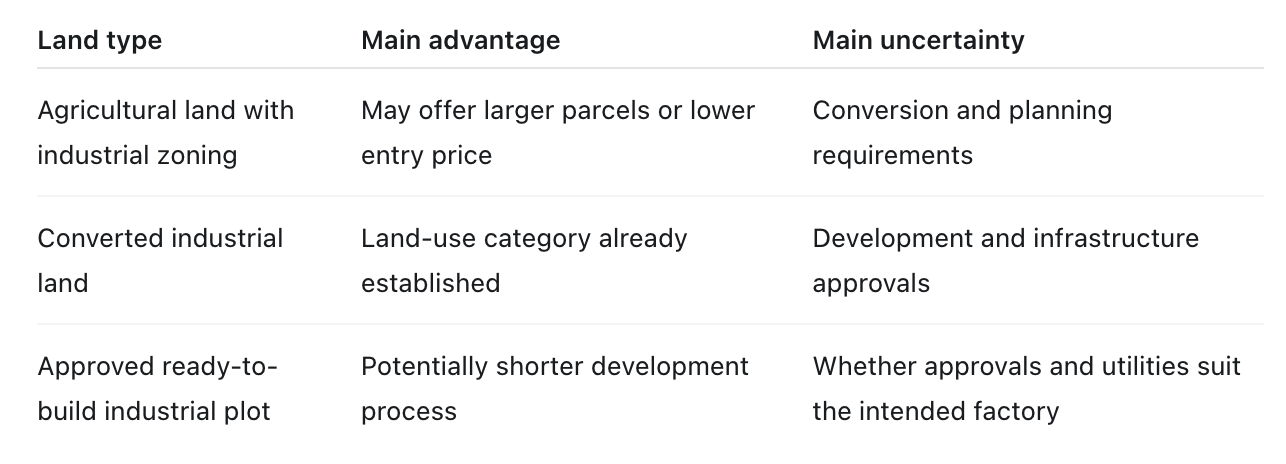
Even a ready-to-build plot requires project-specific verification. A factory with unusually high electricity usage, water, wastewater or environmental requirements may still need additional approvals and infrastructure.
Why this matters in Kapar and other Selangor industrial corridors
Kapar remains an established manufacturing location within the wider Klang industrial ecosystem.
Manufacturers can find a mixture of older factories, newer industrial developments, vacant industrial land and agricultural parcels with potential for future industrial use.
The same distinction arises in parts of Kuala Langat, Jenjarom, Banting and northern Selangor.
For owner-occupiers, the correct property depends partly on when the factory must begin operating.
A company planning expansion five years ahead may tolerate a different approval programme from one needing additional production within 12 months.
Practical takeaway
The Pantech transaction demonstrates that development certainty has economic value. Manufacturers comparing industrial land should establish the likely approval pathway and construction timeline before deciding that one parcel is cheaper than another.
The relevant question is not simply how much the land costs. It is when the factory can realistically become operational.


