

Selangor's Zero Discharge Policy (ZDP) is no longer only an environmental policy announcement. The state water authority is issuing licences, visiting industrial premises and checking whether licence holders meet their conditions. For a manufacturer evaluating an existing factory or planning a new production facility, wastewater management has become a more visible operating and compliance issue.
In an update reported on 20 October 2026, the Selangor Water Management Authority (LUAS) said about 20% of industrial wastewater is being reused on average across industries, while nearly 7,000 licences have been issued across the policy's regulated activities. LUAS also reported that approximately 30%–40% of targeted areas had been covered by its premises visits. These are broad implementation indicators, not a reuse requirement imposed on every individual factory. [1]
What is Selangor's Zero Discharge Policy?
The policy seeks to reduce the quantity of return water and pollutants discharged into Selangor's water resources and encourage reuse and recycling. It is implemented under the Discharge of Return Water, and Entry or Discharge of Waste and Pollutants (State of Selangor) Licensing Regulations 2024, made under the LUAS Enactment 1999. The regulations were gazetted on 20 June 2024; the policy was launched in August 2024. [2]
The phrase zero discharge describes the direction of the policy. It should not be read as a universal statement that every factory must immediately discharge literally zero wastewater. The legal requirements depend on the scheduled activity, the type of discharge, applicable licences and licence conditions. Nor does a reported 20% sector-average reuse rate mean every factory is legally required to recycle 20%.
Which factories may be affected?
The regulations identify 13 categories of scheduled activities, including industry, development and earthworks, sewage treatment and solid-waste management. LUAS's official guidance says the framework applies to relevant activities across Selangor, not only premises located immediately beside a river. [2]
A manufacturer should first identify how process water, cooling water, cleaning water and other streams leave its premises. Some operations have substantial process effluent; others have limited industrial discharge. A facility's specific obligations cannot be established solely from its land title or the label “light industrial.”
AK versus BP: two different licence functions
AK — Licence for Discharge of Return Water. This addresses the quantity of return water discharged from the relevant activity.
BP — Licence for Entry or Discharge of Waste and Pollutants. This addresses the discharge of wastes or pollutants and their characteristics.
Depending on the activity and discharge pathway, the relevant AK and/or BP requirements must be confirmed with LUAS. The Federation of Malaysian Manufacturers (FMM) advised members in August 2026 to review their operations and determine which licences apply rather than assume that all premises have identical obligations. [3]These state licences do not** automatically replace other relevant requirements, such as federal environmental controls, sewerage permissions, planning or building approvals.
What changed in October 2026?
The October update provided evidence of how enforcement is progressing. LUAS reported nearly 7,000 licences across regulated categories and said it was conducting door-to-door visits in Selangor's industrial areas. Around 30%–40% of the areas targeted by the exercise had been covered. The authority said premises receiving a notice were given 14 days to respond and apply for the relevant licence. It had also begun checking existing licence holders' compliance with conditions, including water-quality reporting. [1]
This is an implementation update to a policy introduced in 2024, not a newly enacted law in October 2026.
For factories, the immediate implication is that having an older premises, a longstanding industrial use or an existing effluent treatment system is not sufficient evidence of full licensing compliance.
Why wastewater compliance affects factory selection
Food processing and beverage production
These operations may generate cleaning, organic and process wastewater. A factory with inadequate effluent treatment space or drainage may require additional works before a proposed operation is suitable.
Chemicals, coatings and surface treatment
The nature of the wastewater can matter as much as the volume. Manufacturers should evaluate process chemicals, pollutant concentrations, treatment needs and the discharge route.
Precision engineering and electronics
Some processes need treated or ultrapure water, chemical handling and specialised waste management. The factory's utility and wastewater infrastructure may influence the cost and feasibility of occupation.
Warehousing and low-process-water operations
Not every industrial occupier has the same discharge profile. A warehouse should not be assumed to have the same obligations as a wet-process manufacturing facility; its actual activities and drainage still need to be assessed.
Does recycling wastewater reduce factory costs?
It can, but the answer depends on the process. Reusing suitably treated water may reduce demand for purchased water or the quantity discharged. The benefits must be weighed against treatment equipment, pumping, testing, maintenance and energy costs.
For example, a factory using 100 cubic metres of process water per day could potentially reduce fresh-water demand if some treated water is technically suitable for reuse. That is a hypothetical operating illustration, not a claim about any specific factory or a prescribed ZDP percentage.
The best reuse option depends on the water-quality requirements of the manufacturing process and the applicable regulatory conditions.
What should a manufacturer verify before acquiring or expanding a factory?
The operational assessment should cover the water balance, source and destination of wastewater, existing treatment systems, available land for upgrades, historical monitoring records, and whether the current or proposed activity falls under the 2024 regulations.
A factory may have a valid CCC and industrial land-use category while still requiring a separate review of effluent discharge and LUAS licensing. A purchaser should not confuse building approval with environmental operating compliance.
For a new plant, wastewater infrastructure should be considered alongside electrical supply, water intake, machinery layout and production capacity. Retrofitting a constrained site can be significantly more disruptive than designing the relevant systems into the initial facility.

How to apply for LUAS licensing
LUAS provides an online application route through its Licensing of Effluent Discharge System (LEDS). Its official guidance directs applicants to register through the e-licensing portal, access LEDS and select the applicable AK or BP licence application. [2]
Manufacturers should verify the current application documents, technical submissions, fees and conditions with LUAS. FMM's August 2026 circular notes that failure to obtain a required licence may attract a penalty of up to RM50,000 or two years' imprisonment, or both, while non-compliance with licence conditions may attract a penalty of up to RM10,000 or six months' imprisonment, or both, subject to the applicable legal provisions. [3]
What does this mean for industrial property in Klang, Shah Alam and southern Selangor?
Established industrial areas contain factories built for different production processes and under different regulatory regimes. In Klang, Kapar, Shah Alam, Jenjarom and Banting, two similarly sized factories can have very different wastewater infrastructure and compliance costs.
For manufacturers, the distinction between land that can accommodate a factory building and a facility suitable for the intended manufacturing activity is essential. A relatively low purchase price is not decisive if substantial treatment infrastructure, approvals or operating restrictions are required.
The ZDP also has a broader economic purpose: protecting rivers and reducing the risk of industrial pollution affecting water treatment plants. The state reported no water-treatment shutdown attributed to industrial pollution during 2025 and through 30 July 2026, while acknowledging that monitoring and other programmes also contributed. That should not be attributed solely to ZDP. [1]
Key takeaways
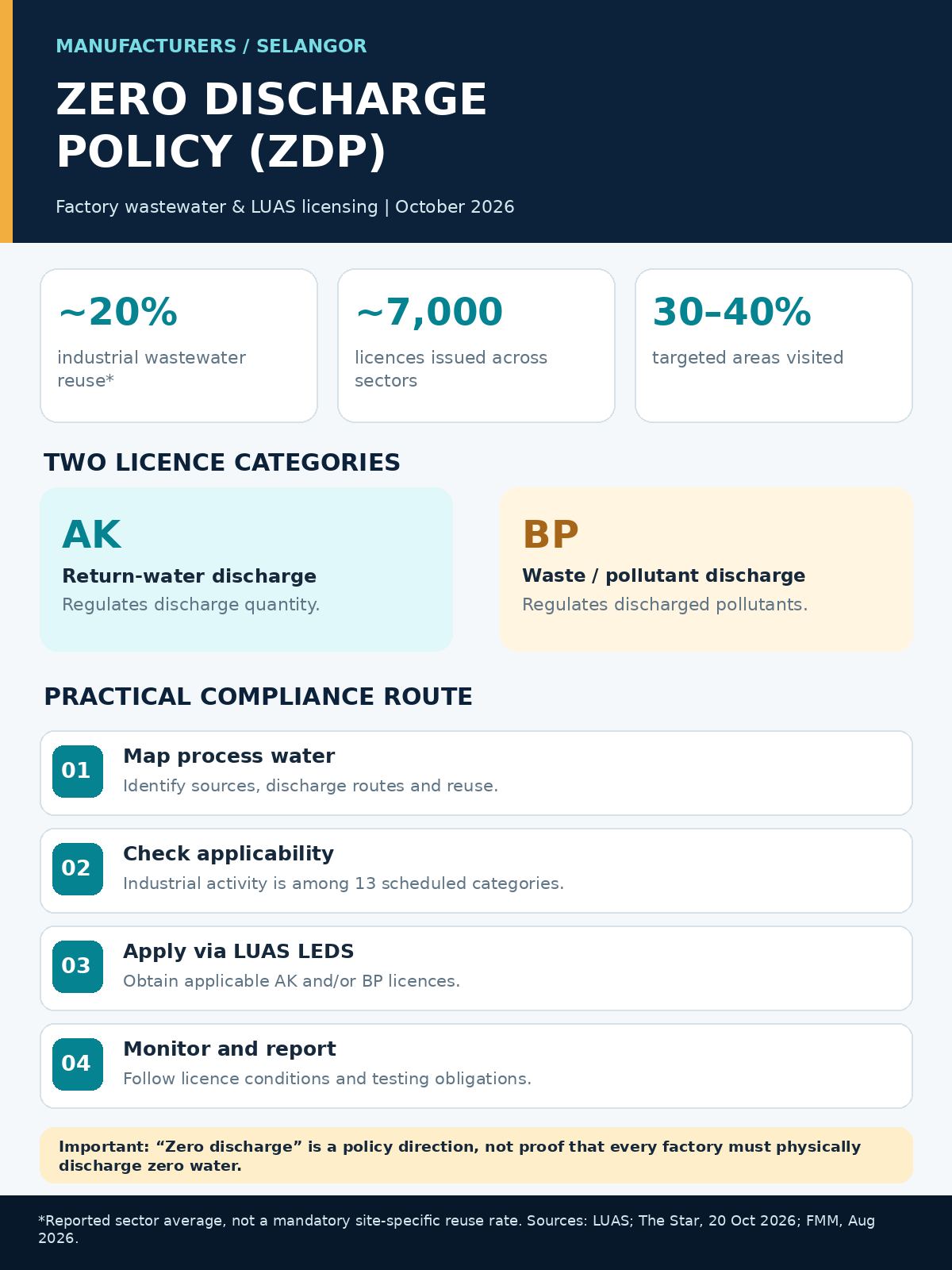
- The policy is already in force. The 2026 news is about licensing coverage and enforcement, not a new law.
- AK and BP serve different functions. The correct licences depend on the activity and discharge.
- The reported 20% reuse rate is an average, not a universal legal target.
- Factory suitability includes wastewater infrastructure. Industrial zoning and CCC alone do not settle environmental compliance.
- Water reuse can have commercial value, but only after a site-specific technical and cost assessment.
Contact Us
Manufacturers seeking factories or industrial land in Port Klang, Sepang, Kapar, Jenjarom, Banting or the wider Selangor and Negeri Sembilan industrial market can contact Alvin Chin to discuss properties suited to their operational, utility and expansion requirements. Regulatory suitability should be confirmed with the relevant authorities and qualified technical advisers.


